
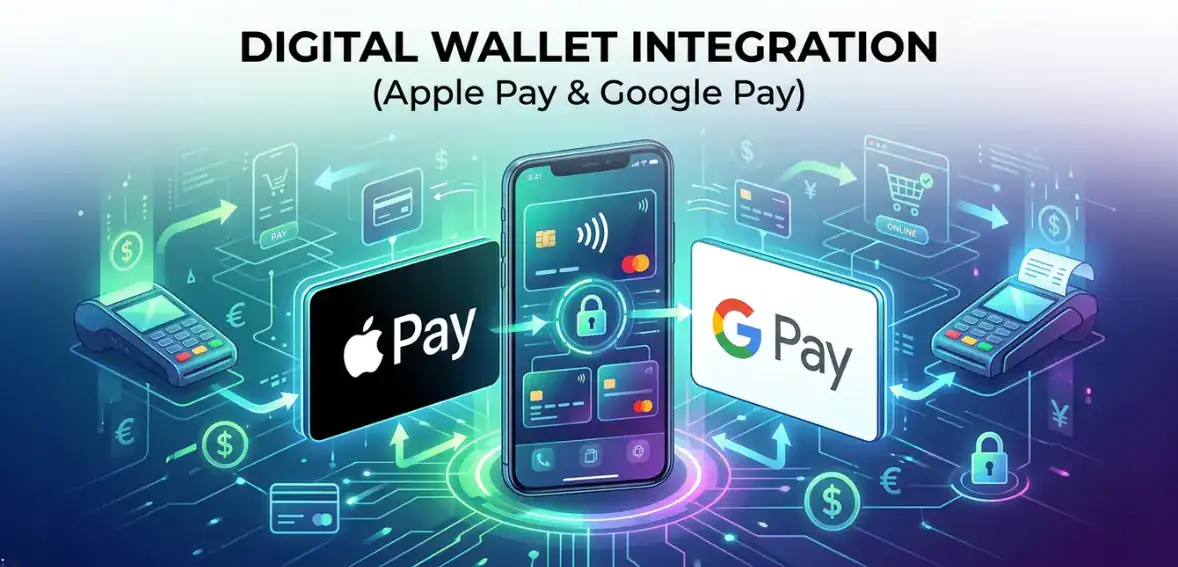
Digital wallet integration, including Apple Pay and Google Pay, is becoming an essential part of modern payment systems. These mobile wallets allow customers to make fast and secure payments using their smartphones or wearable devices. For businesses, supporting digital wallets can improve checkout speed, meet changing customer expectations, and provide a convenient contactless payment option for both online and in-store transactions.
Increasing Mobile Wallet Integration
Mobile wallets are also one of the fastest-growing payment technologies in recent years. According to Statista, almost half of the world’s e-commerce transactions in 2022 were conducted through mobile wallets. Currently, there are 2.8 billion mobile wallets in use across the world, which indicates the popularity of this payment technology.
The Asia-Pacific region alone represents more than half of the world’s mobile payment wallets. A report by Daxue Consulting revealed that around 64% of China’s population uses mobile payments, which indicates the growth of mobile wallets in the transaction process of the country. Currently, mobile wallets are also gaining popularity in offline retail stores across the world.
According to the 2022 CB Insights Future of the Wallet report, the use of mobile wallets has risen considerably after 2021. The main reason for this is the change in consumer behavior. Consumers look for convenient ways to pay and would like to handle their finances from one place instead of using different banking apps.
The smartphone has a significant role in this regard. Smartphones are already an integral part of people’s lives. People use their smartphones for communication, business, entertainment, and purchasing. Many people check their smartphones several times a day. In some countries, the number of smartphones is even higher than the number of people.
This means that many people own more than one smartphone. Since the smartphone is always with them, it is only natural that they use it for payments. Mobile payment services have made it easy to store different payment options and make payments from the smartphone itself. This is why Google Pay and Apple Pay have gained popularity so quickly.
Google Pay and Apple Pay are some of the most popular digital wallet services. Although these services are available on most Android and iOS devices, some countries took time to adopt them. For instance, Germany took until 2018 to adopt Apple Pay and Google Pay. Google Pay is available in 189 countries, and 72 of these countries support contactless payments using Google Pay.
Although it is hard to determine the number of users worldwide, it is estimated that about 80% of surveyed consumers used Google Pay between April 2022 and March 2023, according to Statista. Apple Pay has also taken time to grow. In 2022, it was available in over 80 countries.
Research by Loup Ventures indicates that nearly three-quarters of iPhone users in the United States use Apple Pay, which is 25% higher than in 2020. Apple has also indicated that over 90% of retailers in the United States accept Apple Pay. These statistics clearly indicate that mobile wallet adoption continues to rise, providing businesses with more opportunities to enable faster and more convenient digital payments.
Benefits of Digital Wallet Implementation for Merchants
For the merchant, the adoption of digital wallets like Apple Pay and Google Pay can enhance the customer experience as well as the efficiency of payments. The first key benefit is the increased conversion rate. Customers can make payments quickly without the need to enter their card information, which increases the likelihood of successful transactions. Digital wallets enable customers to earn rewards, cash back, and store multiple cards, giving customers more flexibility when making payments.
The second key benefit of digital wallets for merchants is improved customer retention. When merchants provide customers with convenient and fast mobile payment solutions, they are likely to retain their customers. Digital wallets enable customers to make payments easily through websites, mobile apps, QR codes, and NFC-enabled terminals.
Digital wallets can also assist in fighting fraud and chargebacks. Payments made through digital wallets are processed through tokenization, which ensures that instead of the credit card details, a secure code is used for every transaction. Moreover, biometric authentication, such as fingerprint or facial recognition, provides an additional layer of security. Businesses can also benefit from the data provided by the transactions, which can assist them in understanding customer behavior and developing targeted marketing campaigns.
Apple Pay Implementation

To integrate Apple Pay into your website or mobile app, you follow a similar process to other digital wallet services, with a few unique steps to follow for Apple Pay.
Create a Merchant ID
The first step is to register your business on the Apple developer site and create a Merchant ID. This ID is a unique identifier for your business when processing Apple Pay payments.
Generate a Payment Processing Certificate
The next step is to create a payment processing certificate. This certificate is used to encrypt payments so that customer information is protected when the payment is transmitted to the Apple Pay servers.
Enable Apple Pay in Xcode
If you are implementing Apple Pay on a mobile app, you must enable it in Xcode, which is the development environment used by Apple. This involves adding your Merchant ID and enabling Apple Pay functionality for your app.
Set Up Website Authentication
If you are implementing Apple Pay on a website, you must also create a Transport Layer Security (TLS) certificate that is associated with your Merchant ID. This certificate is used to authenticate your domain and enable secure functionality of Apple Pay on your website.
Google Pay Implementation
To integrate Google Pay with your payment system, a few major steps need to be taken.
Create a Merchant ID
Firstly, you need to register your business with the Google Pay Business Console. This will provide you with a unique Merchant ID, which will be required during transactions.
Request Production Access
In order to use Google Pay, your payment system setup needs to meet a few major requirements. This includes using a payment gateway that is supported by Google Pay, having a secure server environment, and meeting the security requirements set by the PCI DSS standard.
Integrate the Google Pay APIs
Next, the Google Pay APIs need to be integrated with your website or app. This includes loading the required libraries, specifying the correct version of the Google Pay APIs, and placing the Google Pay button on the checkout page according to Google Pay specifications.
Submit for Approval and Launch
Finally, your setup needs to be submitted for approval through the Google Pay Business Console. Once your setup has been approved by Google Pay, you can enable Google Pay for your customers.
Promoting Mobile and Digital Wallet Payments to Merchants
When dealing with merchants, agents should emphasize the benefits associated with mobile and digital wallets, which include Apple Pay and Google Pay. One of the most significant advantages to emphasize is the “tap and go” benefit associated with digital wallets. Digital wallets allow consumers to make payments in a timely manner using their mobile devices or smartwatches, thereby enabling them to minimize waiting time while paying for goods in the store.
Another significant benefit to emphasize to the merchant is the security benefits associated with digital wallets. Digital wallets use tokenization and other security features like facial recognition to protect consumers’ payment information and minimize fraud cases associated with credit cards.
The next important aspect to highlight to the customer would be the customer demand and the need for modern payment solutions. Many consumers today wish to make contactless payments as they are convenient and time-saving. Digital wallets can be a great option for merchants to cater to the needs of their consumers and retain them rather than losing them to competitors who already offer the service of mobile payments.
Agents can further clarify to the customer that the digital wallet allows them to make payments using multiple payment options through a single device. Consumers can add multiple cards to the digital wallet and can use the one that offers them the most benefits, rewards, cashback, etc. This can encourage the customer to shop at the same store again.
Lastly, the agents can inform the customer that the digital wallet can be integrated with the existing POS system of the merchant, which allows contactless payments. In most cases, the merchant would only need to activate the feature on their system, and it would be ready for them to start using the digital wallet for payments.
How Agents Can Help Merchants Overcome Common Challenges of Implementing Digital Wallets
Though digital wallets like Apple Pay and Google Pay provide a lot of advantages, merchants may be hesitant to use them for their businesses, as they may be concerned about the usage, technical specifications, security, and integration complexities associated with digital wallets. Agents can help merchants feel more confident about accepting digital wallet payments.
For example, merchants may be concerned that digital wallet transactions may be less common in their area. In certain regions, especially in smaller towns or cities, merchants may be concerned that digital wallet transactions may be less common, especially in regions where cash transactions are more common. The agent can clarify to the merchant that digital wallet transactions do not replace any of the current transactions, but rather provide customers with another option to pay for their transactions in a more convenient manner.
With digital wallet transactions, merchants can provide their customers with another option to pay for their transactions, and as more customers start to use digital wallet transactions in the future, merchants will already be equipped to handle that as well.
The other issue that the merchant usually complains about is the technical requirements set by the digital wallet providers, like Apple and Google. These companies have set specific standards for businesses to comply with in order to use their digital wallets. Agents can use this opportunity to explain to the merchant that most POS systems and payment processors used by businesses today already comply with these requirements. In most cases, the digital wallet feature does not need to be added to the POS system or payment processor; rather, it can be enabled directly through the payment processor or POS software.
Security and privacy issues are also common among businesses when they consider digital wallets. Agents can use this opportunity to explain to the merchant that digital wallet payments are designed to incorporate security features to protect the payment information of the customer. Instead of using the real card number to make the payment, tokenization is used to protect the card information. Moreover, the payment will also be authenticated using the customer’s fingerprint, facial recognition, or device passcode.
Another area that may cause confusion for merchants is the complexity of integrating systems for digital wallet payments. The process may involve various technologies such as NFC for contactless payments, payment gateway integration, and POS terminal integration, among others.
The merchant may be comforted by the fact that most payment processors and POS terminals have tools and step-by-step guides for integrating these systems into their existing infrastructure. The merchant may not have to install any additional hardware, and in most cases, they may only have to update their existing terminal settings to start accepting digital wallet payments.
Another aspect that the merchant may be comforted by is the long-term benefits of integrating digital wallet payments into their existing infrastructure. As the use of contactless payments becomes more widespread, merchants who have incorporated this technology into their existing infrastructure may be able to offer customers a faster and more efficient way of paying for goods and services, thus meeting the changing needs of customers in the market.
Conclusion
Digital wallet integration with Apple Pay and Google Pay is also becoming a significant feature for businesses to provide quick and convenient payment options to their customers. Digital wallets enhance the speed of transactions, provide greater security to transactions, and allow for contactless transactions for customers. With more customers preferring to use digital payments, businesses can provide their customers with a better experience by integrating digital wallets with their systems.
FAQs
- What is the concept of integrating digital wallets?
It enables businesses to accept payments from customers through mobile wallets like Apple Pay and Google Pay in a secure manner.
- What is the process of Apple Pay for merchants?
Customers can use Apple Pay and Apple Watch to make payments, and these transactions are secure through tokenization and biometric authentication.
- Can Google Pay be used for in-store and online transactions?
Yes, Google Pay allows customers to make in-store payments through contactless technology and online transactions through websites and mobile apps.
- Are digital wallet payments secure?
Yes, these payments are secure through tokenization, encryption, and biometric authentication to prevent any fraud on customers’ payment information.
- Why should businesses consider mobile wallets?
Mobile wallets are faster in transaction, provide convenience to customers, support contactless payments, and are secure for customers.